10 Cold Email Templates That Actually Get Replies in 2026
After 8 years of B2B outbound, the patterns that consistently produce 5-10% reply rates are surprisingly stable. The variables that change every quarter are deliverability conditions, spam filter sensitivity, and what the inbox feels saturated with. The templates below are the 10 that survived 2024 and still landed meetings into 2026, with the subject line, the body, and the reason each one works the way it does.
Before You Copy These Templates
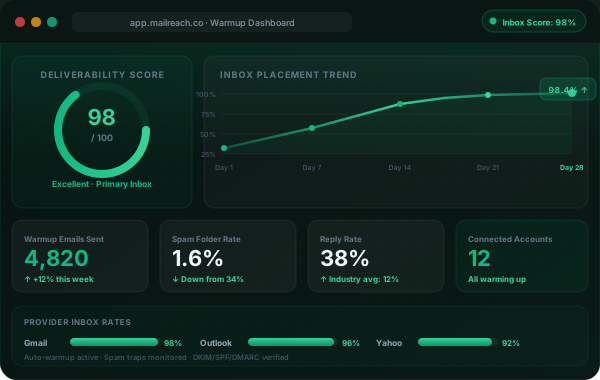
These templates are starting points, not scripts. Personalize every email with the prospect's name, company, and a specific observation about their business. A template sent to 1,000 people without personalization will get a 1% reply rate. The same template with one genuine personalized line gets 5–8%. Also: warm up your inbox with Mailreach before sending, even great copy won't help if your emails land in spam.
Template 1: The Clean Cold Intro
Use this as your first email to a cold prospect. Short, specific, no fluff. The goal is one reply, not to close the deal.
Hi {{First_Name}},
Noticed [Company Name] is hiring SDRs, usually a sign you're scaling outbound.
We help B2B companies like [similar company] book 15–20 qualified calls/month using cold email without cold calling.
Worth a 15-minute conversation?
- [Your name]
Why it works: The hiring observation is a genuine trigger, it's specific, not generic. The similar company social proof adds credibility. The ask is small (15 minutes) and low-commitment. Under 60 words total.
Template 2: The Pain Point Opener
Lead with a problem you know they likely have. Don't mention your solution until the second sentence.
Hi {{First_Name}},
Most cold email campaigns fail not because of bad copy, but because the emails never reach the inbox.
We helped [Client Name] go from 22% to 96% inbox placement in 4 weeks, which took their reply rate from 1.2% to 8.4%.
I can walk you through exactly what we did in 20 minutes. Interested?
- [Your name]
Why it works: Opens with a counter-intuitive insight (not your pitch). The specific numbers (22% → 96%, 1.2% → 8.4%) are credible and concrete. The ask is a 20-minute call with a clear "what you'll get" framing.
Template 3: The Case Study Email
When you have a relevant result to share, lead with it. Let your client's success sell for you.
Hi {{First_Name}},
[Client Name], a [industry] company similar to [Prospect Company], ran a 30-day cold email campaign using our system and signed 25 new clients from 312 replies.
We built their list in Apollo, warmed their inboxes, wrote a 4-email sequence, and managed delivery. They closed deals averaging $3,500 MRR.
Worth seeing if the same approach could work for {{Company}}?
- [Your name]
Why it works: Specific results beat vague claims. "25 clients, 312 replies, $3,500 MRR" is far more compelling than "we help companies grow revenue." The case study framing positions you as experienced, not just pitching.
Template 4: The Compliment + Question
A genuine compliment (not flattery) plus an honest question. Works well for founder-to-founder outreach.
Hi {{First_Name}},
Read your LinkedIn post about [specific topic] last week, the point about [specific insight] is something we're seeing a lot with our clients too.
I help [ICP description] with [specific outcome]. Given what you shared, curious if [specific pain point] is something you're actively working on?
Happy to share what's been working for similar companies.
- [Your name]
Why it works: References something real the prospect said publicly, proves you've done research. The question format invites a reply without making a hard ask. Conversational tone, not salesy.
Template 5: Follow-Up #1 (Day 4)
Most replies come from follow-ups. This one is a simple nudge that adds value without being pushy.
Hi {{First_Name}},
Bumping this up in case it got buried.
One thing worth mentioning: most companies we work with see a measurable lift in open rates within the first 2 weeks of fixing their deliverability setup. Happy to show you the before/after from a recent client.
Worth 15 minutes?
- [Your name]
Why it works: "Bumping this up" is honest and doesn't apologize for following up. Adds a new hook (the 2-week timeline) that wasn't in the first email. Keeps it short, follow-ups should be shorter than the original.
Template 6: Follow-Up #2, The Different Angle (Day 8)
Don't just repeat email 1. Come from a different angle with a new observation or value add.
Hi {{First_Name}},
Quick observation: I checked {{Company}}'s domain and your DMARC record isn't configured for strict enforcement, which means your domain could be spoofed for phishing attacks, and it's likely hurting your deliverability.
Takes about 10 minutes to fix. Happy to walk you through it on a call or just send you the config.
- [Your name]
Why it works: Provides genuine, actionable value for free. You're demonstrating expertise by finding a real problem. The offer is either a call OR just sending the fix, giving them a low-commitment option to engage.
Template 7: The Social Proof Sequence Email (Day 12)
By email 3–4, use social proof if you haven't already. Name-dropping relevant clients builds trust.
Hi {{First_Name}},
Two of our clients, [Client A] and [Client B], both in [industry], mentioned {{Company}} as a company they respect and thought might benefit from what we do.
We've helped both improve their cold email reply rates by 4–6x in 60 days.
If the timing works, I'd love to share specifically what we did for them.
- [Your name]
Why it works: The "your peers recommended I reach out" framing is powerful social proof. It positions you as trusted by people they know (or respect), not as a random vendor. Only use this template if the client names are relevant to the prospect's industry.
Template 8: The Direct ROI Email
For prospects who respond to numbers. Give them the financial case upfront.
Hi {{First_Name}},
A rough calculation for {{Company}}:
If your average deal is $[X] and you close 20% of qualified calls, you'd need [Y] calls/month to hit $[Z] in new revenue.
Our system books 15–20 calls/month for companies your size through cold email. That's roughly $[projected revenue] at your deal size.
Worth checking if the math works?
- [Your name]
Why it works: Shows the business outcome in the prospect's own terms. The calculation feels personalized (even if you built it with their public data). Decision-makers who think in revenue respond well to ROI framing.
Template 9: The Competitor Angle
Use carefully, reference what a competitor is doing well to spark competitive urgency.
Hi {{First_Name}},
Not sure if you've noticed, but [Competitor Company] has been running aggressive cold outreach in [specific market/region] for the past 60 days.
We work with several companies in [industry] and can see when email volumes spike. They're clearly scaling outbound.
Happy to share what approach is working in your space right now, no strings attached.
- [Your name]
Why it works: Competitive intelligence is valuable to any executive. The "no strings attached" framing reduces pressure. Only use this if the competitive observation is real, never fabricate competitor intel.
Template 10: The Breakup Email (Final Follow-Up)
The last email in your sequence. Paradoxically, this often gets the highest reply rate of all follow-ups.
Hi {{First_Name}},
I've reached out a few times without a response, totally understand if now isn't the right time or this isn't relevant.
I'll stop following up after this. But if cold email performance ever becomes a priority, I'd love to help.
Just reply "interested" and I'll send over some info.
Either way, best of luck with {{Company}}.
- [Your name]
Why it works: The breakup email triggers the "wait, maybe I should respond" reaction. Prospects who were busy, distracted, or on the fence often reply to breakup emails because the stakes feel clear. The "just reply 'interested'" makes it extremely low-friction to respond.
How to Deploy These Templates at Scale
Copy-pasting these manually would take forever. Here's the tool stack that lets you run these as automated sequences:
Apollo.io, Lead Finding
Build your targeted prospect list, find verified emails, and run your sequences directly in Apollo. See Apollo review →
Instantly.ai, Sending at Scale
Unlimited sending accounts, best deliverability. Import your Apollo lists and run these sequences with full A/B testing. See Instantly review →
Mailreach, Inbox Warmup
Warm up your inboxes before launching. Without warmup, even the best templates land in spam. See Mailreach review →
Pipedrive, CRM
When leads reply and qualify, push them to Pipedrive for pipeline management. See Pipedrive review →
{{merge_tags}} — all in your browser, nothing uploaded.
The 4-Email Sequence Structure That Works
| Step | Template | Send timing | Length |
|---|---|---|---|
| Email 1 | Clean intro or pain point | Day 1 | 50–75 words |
| Email 2 | Follow-up #1 (value add) | Day 4–5 | 40–60 words |
| Email 3 | Different angle / social proof | Day 8–10 | 50–70 words |
| Email 4 | Breakup email | Day 14–16 | 40–50 words |
The mistake I see senior SDRs make most often with templates like these is treating the template as the strategy. A clean cold intro that books 8 meetings on day 1 will book 2 by week 6 if it's the only thing the prospect sees from your team. The trick that's kept me at the 6-8% reply band over the last year isn't better templates; it's a quarterly rotation of which two are the openers across the team. We A/B the pain-point opener against the social-proof opener for six weeks, take whichever wins on reply rate, then pair the winner with a different runner-up the next quarter. Templates 1 and 2 in this guide get rotated against templates 3 and 7 in mine. Stop treating one template as "the good one" and you stop watching it degrade.