The most expensive email tool in your stack probably isn't Mailreach. It's landing in spam.
Here's a scenario that plays out more often than most people admit. Imagine sending 2,000 cold emails over six weeks. You've got solid copy, a well-targeted Apollo list, good follow-up sequences, and a domain that's been aged for two months. You check the campaign stats: 11 replies. An 0.55% reply rate on outreach that should have been pulling 3-4%.
Then you run a GlockApps inbox placement test on a whim. Results: 38% primary inbox, 44% spam, 18% promotions. Nearly two-thirds of your emails were never seen. You'd just flushed weeks of work, and a meaningful chunk of your Apollo subscription cost, because the warmup was either skipped entirely or done half-heartedly with a free tool that wasn't cutting it.
Adding Mailreach at $25/month and running a proper warmup over the next three weeks changed the picture. The same domain, the same copy, the same list pulled a 3.1% reply rate two months later. The difference wasn't the tool. The difference was deliverability.
The reason the pricing question is even worth a full article: the headline cost ($25) is trivial, but the real cost question is what you're already losing without it. That's the number that actually decides whether each tier makes sense.
Quick verdict: Mailreach is $25/month for 1 mailbox (Starter), $49 for 5 (Scale), $149 for unlimited (Business), with annual billing saving ~20% and a 7-day trial. For anyone running more than one sending inbox, start on Scale; the break-even versus stacking Starter seats hits at the second mailbox.
Mailreach Plans & Pricing (2026)
Mailreach keeps its pricing straightforward. You pay per mailbox, the more inboxes you need to warm up and monitor, the higher the tier. Here is a full breakdown of all three plans.
- 1 mailbox warmup
- Inbox placement tests
- Spam word monitoring
- Blacklist monitoring
- Deliverability score dashboard
- Reply rate monitoring
- Gmail, Outlook & SMTP support
- 5 mailboxes included
- Everything in Starter
- Priority support
- Additional mailboxes ~$10-15/mo each
- Team member access
- Campaign-level reporting
- Unlimited mailboxes
- Everything in Scale
- White-label option
- Full API access
- Dedicated success manager
- Advanced team features
- Custom reporting
What You Actually Get for $25/Month
The Starter plan might look minimal on paper, one mailbox, $25/month. But the feature set included at this price point is what separates Mailreach from budget alternatives that just exchange emails between fake accounts. Here's what that $25 actually buys.
The Warmup Network
Mailreach operates one of the largest warmup networks available, over 500,000 real email accounts that send and reply to your emails in natural patterns. This isn't a collection of dummy inboxes. These are real accounts with real engagement history, and when they interact with your emails, it sends genuine positive signals to Gmail and Outlook's spam filters.
For context: many budget warming tools operate networks of 5,000 to 30,000 accounts. The difference in signal quality is significant, especially for Gmail, which has become increasingly sophisticated at identifying synthetic engagement. A larger, more diverse network means the warm-up signals look more like real human correspondence.
Inbox Placement Tests
This is the feature that most distinguishes Mailreach from tools that only do warmup. Before you launch a campaign, you can send a test email through Mailreach's placement testing system and see exactly where it lands, primary inbox, promotions tab, or spam, across multiple email providers simultaneously.
Run this test before launching any major campaign sequence. A 10-minute placement test has saved more than one sender from wasting a 500-contact list on a domain that was quietly getting filtered.
Spam Word Monitoring
Mailreach scans your email copy and flags words, phrases, and patterns that commonly trigger spam filters. In 2026, spam filter triggers have evolved well beyond the obvious stuff like "FREE MONEY" or excessive exclamation points. Certain URL structures, HTML formatting choices, and even subtle phrasing patterns can flag emails. Mailreach's monitoring catches these before they cost you placements.
Deliverability Score Dashboard
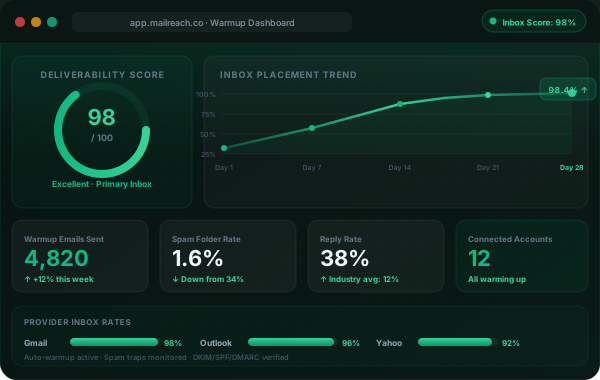
Every mailbox you connect gets a running deliverability score. This score combines your domain's spam reputation, blacklist status, SPF/DKIM/DMARC configuration health, and engagement signals into a single number. Watch this score. If it drops, investigate before sending your next campaign sequence.
500K+ Real Accounts
Industry-leading warmup network built from genuine email accounts with authentic engagement history.
Placement Testing
Test where your emails actually land, primary, promotions, or spam, before sending live campaigns.
Spam Monitoring
Catches spam trigger words and blacklist listings before they derail your deliverability.
Reply Rate Tracking
Monitor actual reply rate trends to catch deliverability problems as they emerge, not after the damage is done.
The ROI Math: Does Mailreach Pay for Itself?
Let's run the numbers honestly, because the case for Mailreach really does come down to math.
Suppose you're using cold email to acquire B2B clients. A single signed client generates roughly $3,000 in value over their first contract. Your close rate on qualified leads, people who reply to your outreach and take a call, is 1 in 10. That means for every 10 replies you generate, you close one client worth $3,000.
Now, your close rate on cold email contacts (before a reply) sits at roughly 1 in 100 with a healthy 3% reply rate. But your current inbox placement rate is around 40%, meaning 60% of your emails never reach the primary inbox. Under those conditions, to generate 100 replies, you need to send approximately 250 emails to primary-inbox recipients, but you're actually sending to 625 total contacts because only 40% land correctly.
With Mailreach running a proper warmup, a 2-to-3-week-old domain on a fresh sending account can achieve 90-95% primary inbox placement. At 95%, those same 625 sends produce nearly 590 primary inbox placements. At a 3% reply rate on properly delivered emails, that's 17-18 replies per 625 sends instead of 7-8.
One extra converted lead per year, just one, at $3,000 contract value more than covers 10 years of Mailreach Starter subscriptions. One extra client per quarter pays for annual Business plan access with budget to spare.
The ROI argument isn't subtle. The question isn't whether Mailreach pays for itself. The question is whether you're currently leaving enough volume on the table that the improvement in placement rates will materially change your results. And for anyone sending more than 50 cold emails per week, the answer is almost certainly yes.
When clients tell me Mailreach is "another $25 I'm not sure I need," I reframe it against the line item they never count: wasted lead data. If you're pulling verified contacts from Apollo at roughly 1 credit each and 60% of your sends land in spam, you're effectively burning 60% of every list's data cost on emails nobody sees. On a 1,000-contact campaign that's hundreds of wasted credits per send, every send, indefinitely. The $25 warmup tool isn't a new expense on top of your stack; it's what stops you from setting fire to the most expensive part of the stack you already pay for. I've never seen the ROI math come out against it for anyone sending real volume.
Is the 7-Day Free Trial Enough to Test Mailreach?
Mailreach offers a 7-day free trial covering 1 mailbox with full feature access. It's a generous trial in terms of features, you get everything including placement testing, spam monitoring, and the full warmup network from day one.
However, there's an honest caveat: email warmup is a process that takes time. A domain going from cold to fully warmed typically requires 14-30 days for the positive signals to meaningfully accumulate and for your deliverability score to reflect them. Seven days will show you the trend, you'll see the score improving, the warmup emails being sent and replied to, but you won't see the full result within the trial window.
If you're testing on a domain that's already been warmed or sending for a while, the placement tests and spam monitoring features will give you immediate, actionable value within the 7-day window. The trial is most limited for brand-new domains where you're starting the warmup process from scratch.
The other thing worth knowing: you don't need a credit card to start the trial. That reduces the friction of testing, and frankly, a tool that doesn't require payment information to try is making a confident statement about its ability to convert users on merit.
Mailreach vs. Competitors: Price Comparison
How does Mailreach pricing stack up against the other major warmup tools? Here's a direct comparison across the most commonly used options.
| Tool | Entry price | Per mailbox | Free trial | Network size | Inbox testing |
|---|---|---|---|---|---|
| Mailreach our pick | $25/mo | $25 (Starter) | 7 days | 500K+ real | Yes |
| Lemwarm | $29/mo | $29/mailbox | No | Large (real) | No |
| Warmup Inbox | $15/mo | $15/mailbox | Yes | Medium | No |
| Instantly Warmup | Bundled ($37+) | Unlimited | Yes | Large | No |
| MailWarm | $49/mo | $16/mailbox (3 incl.) | No | Medium | No |
The table tells an important story. Mailreach is not the cheapest entry point, Warmup Inbox at $15/month wins on raw price. And if you're already paying for Instantly, its built-in warmup is effectively free. But Mailreach is the only tool in this comparison that combines a 500K+ real-account network with dedicated inbox placement testing. That combination is what justifies the $10/month premium over Warmup Inbox for most serious senders.
For a deeper dive on individual alternatives, see our guide: 5 Best Mailreach Alternatives (2026).
Who Needs Mailreach (and Who Doesn't)
Mailreach is not for everyone. Here's how to quickly assess whether it makes sense for your situation.
You Should Use Mailreach If:
- You send more than 50 cold emails per week from a dedicated outreach inbox
- You've set up a new sending domain in the last 60 days
- You're running high-value B2B outreach where one missed deal covers months of subscription cost
- You've noticed declining reply rates from campaigns that used to perform better
- You're an agency managing outreach for multiple clients on separate domains
- You want to test deliverability before launching a major campaign sequence
You Probably Don't Need Mailreach Yet If:
- You send fewer than 50 emails per week and are using a well-aged personal email address
- You're in the very early stages of prospecting and haven't built a sending cadence yet
- You're using your primary business domain with a low-volume newsletter rather than cold outreach
- You've just started cold email and are still testing copy and targeting, focus on those fundamentals first
The tipping point for most people is somewhere around 200-300 emails per week. Below that volume, the absolute impact of improved deliverability is smaller. Above it, the math overwhelmingly favors investing in warmup.
Frequently Asked Questions
What $25 Actually Buys You
For anyone running cold email outreach in B2B, the answer is straightforwardly yes. The $25/month Starter plan pays for itself with a single improvement to one campaign's deliverability. The ROI case is not marginal, it's decisive, especially when you consider that most people severely underestimate how much volume is quietly going to spam.
The honest edge cases: if you send fewer than 50 emails per week, or if you're already on an Instantly plan with built-in warmup for a cost-sensitive secondary domain, you might not need Mailreach for every inbox. But for your primary outreach domain, the one your reputation depends on, Mailreach's 500K+ real-account network and inbox placement testing capability are worth every cent.
Start with the 7-day free trial. Run a placement test on your current domain. The data you get in the first 20 minutes will tell you whether this is a problem you need to solve.
Start Mailreach Free Trial →