WhatsApp Broadcast List vs Bulk Sender Software: Limits Compared (2026)
Published Jun 23, 2026 | Last updated: Jul 2026 | 8 min read | Harish Choudhary
Quick Answer
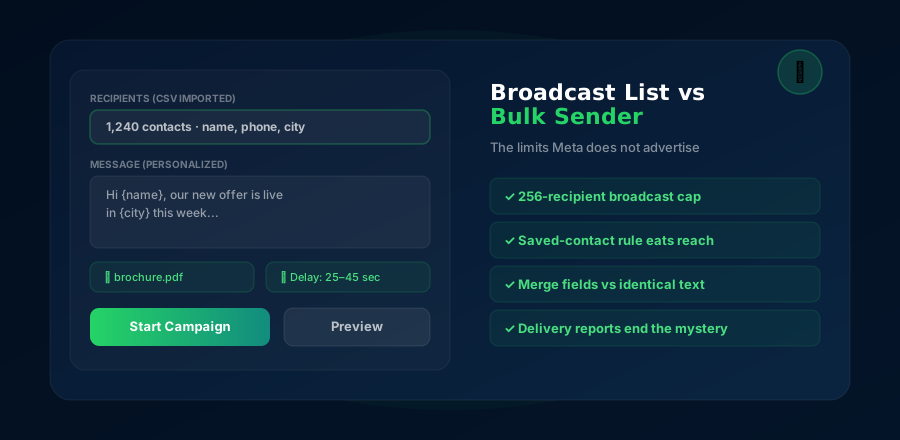
A WhatsApp broadcast list is free but capped at 256 recipients who must have your number saved — and every send is manual with zero personalization. Bulk sender software like WhatsApp Connect Pro messages unlimited CSV-imported contacts directly (no saved-contact requirement), personalizes each message with merge fields, attaches files, auto-delays for safety and reports delivery — for ₹3,000 / $35 per year.
Every business starts the same way: build a broadcast list in WhatsApp, send the first offer, and wonder why half the list never responds — or, as it turns out, never even received it.
Broadcast lists have two structural limits Meta does not advertise loudly, and understanding them explains almost every "WhatsApp marketing is not working for me" complaint. This comparison lays out exactly what each approach can and cannot do, and the point at which upgrading pays for itself.
How Broadcast Lists Actually Work
A broadcast list looks like a group but behaves like BCC: you pick up to 256 saved contacts, write one message, and WhatsApp delivers it as an individual chat to each person. Replies come back privately. It is free, built-in, and takes two minutes to set up — genuinely useful at small scale.
The mechanics matter though: delivery is not unconditional. Which brings us to the limits.
The Two Limits That Break Broadcasts
The saved-contact requirement (the silent killer)
Your broadcast only reaches people who have your number saved in their phone. No error, no undelivered tick pattern you can act on — the message simply never arrives for everyone else. Most customers never save a business's number, so a "256-contact broadcast" routinely delivers to a fraction of that.
The 256 cap and manual everything
Each list holds 256 recipients. A 1,500-customer base means six lists, manually maintained, manually sent, six times per campaign — with no personalization, so every message reads as the broadcast it is, and no delivery report to tell you what happened.
What Bulk Sender Software Does Differently
A desktop bulk sender like WhatsApp Connect Pro connects to your WhatsApp account (QR scan, like WhatsApp Web) and sends each message as a normal direct chat:
- No saved-contact requirement in either direction. Messages arrive like any chat — because they are.
- No 256 cap. Your list is a CSV; a thousand rows is a thousand messages, one campaign.
- Merge-field personalization. {name}, {city}, {last_purchase} — each recipient gets a unique message, which lifts replies and protects your account. (Broadcasts send identical text to everyone, by design.)
- Attachments per campaign. Images, PDF catalogues, price lists.
- Randomized auto delay. Human-pattern sending — the safety feature broadcasts never needed because of their caps, but that direct sending at scale requires.
- Delivery reports. Know exactly which numbers succeeded, clean the dead ones, follow up on the rest.
₹3,000 / $35 per year · No subscription · Access via WhatsApp
Feature-by-Feature Comparison
| Feature | Broadcast list | Bulk sender software |
|---|---|---|
| Cost | Free | ₹3,000 / $35 per year flat |
| Recipient cap | 256 per list | Your list size |
| Recipient must save your number | Yes | No |
| You must save recipients | Yes (phonebook clutter) | No — CSV import |
| Personalization | None — identical text | Merge fields per recipient |
| Attachments | Yes, manual | Yes, per campaign |
| Sending | Manual, per list | Automated with random delays |
| Delivery reporting | None usable | Per-number reports |
| List management | In your phone | Contact manager + spreadsheets |
| Effort per 1,000 contacts | 4 lists × manual sends | One import, one click |
When Broadcast Lists Are Enough
Honest answer: for a lot of micro-businesses, they are. If your list is under ~50 people, they are mostly regulars who saved your number, you send once or twice a month, and "Hi everyone" tone is fine — stay free. Revisit when any of those stops being true.
When to Upgrade (The Break-Even Math)
Three signs the upgrade pays for itself immediately:
- Your list passed a few hundred contacts — manual broadcast management now costs you hours per campaign; the software costs ₹250/month equivalent.
- Delivery mystery. If you cannot say what fraction of your last broadcast actually arrived (you cannot — nobody can), you are marketing blind. Reports end that.
- Flat engagement. Identical broadcast text earns broadcast-level attention. The first personalized campaign to the same list is usually the moment the channel visibly comes alive.
Break-even: if one campaign to your full list produces even one extra sale worth ₹3,000/$35, the year is paid for. For most businesses that is the first send.
Bottom Line
Broadcast lists are a fine free tier with two hard walls: 256 recipients and the saved-contact rule that silently eats your reach. Bulk sender software removes both, adds personalization, attachments, safety delays and reports, and costs less per year than one decent ad campaign. Test the difference yourself — every feature is in the one flat licence.
See WhatsApp Connect Pro Pricing →Where this trips people up
The saved-contact rule causes a very specific illusion worth spelling out: businesses test their broadcast list on themselves and two colleagues — all of whom obviously have the number saved — see it work perfectly, and conclude the channel is fine. Then the real campaign goes to 200 customers, 30 of whom saved the shop number three years ago, and the "campaign" reaches those 30. The metrics that follow (few replies, no sales) get blamed on the offer, the timing, the market — everything except the delivery mechanism that quietly dropped 85% of the audience. If you take one thing from this comparison: before judging WhatsApp as a channel, make sure your messages are actually arriving. A bulk sender's delivery report is worth the license fee for that visibility alone, even before the personalization starts earning replies.