Instantly vs Apollo 2026: Which Builds a Better Cold Email Machine?
Instantly is the best cold email sender in 2026. Apollo is the best cold email lead finder. Understanding that distinction will save you a lot of frustration choosing between them.
Bottom Line Up Front
Instantly wins on: unlimited sending accounts, deliverability infrastructure (300K+ warmup network), AI-optimized send schedules, unified inbox management, and pure cold email performance at scale.
Apollo wins on: 275M+ contact database, email finder with credit system, LinkedIn integration, built-in CRM, intent data, and all-in-one prospecting + sequences in one tool.
Best answer: Use Apollo to find and verify leads. Use Instantly to send to them. Total cost $86/month. Outperforms either tool alone.
Understanding What Each Tool Was Built For
The confusion in this comparison comes from the fact that both tools do cold email, but from completely different starting points.
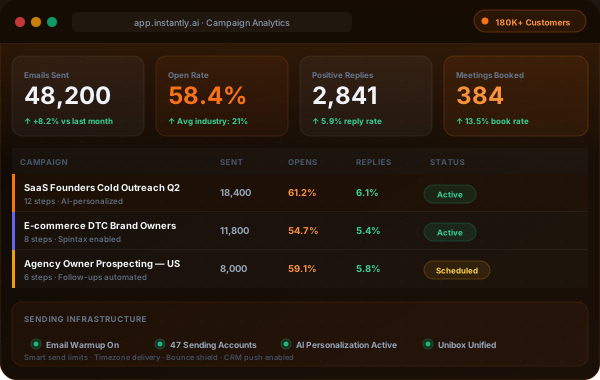
Instantly was built from day one as a cold email sending platform. Its entire product is optimized for one thing: getting your emails delivered to inboxes at scale. Unlimited sending accounts, a massive warmup network, per-account health monitoring, AI-powered sending windows, every feature traces back to the core mission of deliverability and scale.
Apollo started as a sales intelligence and data platform. It built a 275M+ contact database, then added email sequences so sales teams could reach those contacts without switching tools. The sequences work well for moderate-volume outreach, but they weren't designed with the same deliverability obsession as Instantly.
Where Instantly Dominates
1. Unlimited Sending Accounts
This is Instantly's killer feature. Every paid plan, from $37/month Growth, supports unlimited sending email accounts. This matters because serious cold emailers never send from one domain. You set up 3–5 domains, 2–3 inboxes per domain, and distribute your send volume across all of them. This protects your main domain, increases total daily volume, and reduces the blast radius if one account gets flagged.
Apollo caps your sending accounts based on plan tier. On Basic you can connect a handful of accounts. On Professional it expands. With Instantly, there's no ceiling, run 20 inboxes, 50 inboxes, whatever your prospecting volume demands.
2. Dedicated Warmup Network
Instantly's warmup network has over 300,000 real inboxes that automatically exchange emails with your sending accounts. Emails land, get opened, get replied to, get moved out of spam, all automatically, 24/7, training email providers to see your inbox as legitimate.
You can monitor your warmup score per inbox in the dashboard. A score above 85% means you're ready to send campaigns. This visibility lets you spot problems before they tank a campaign. Apollo's warmup relies on a much smaller network and gives you less granular visibility into individual inbox health.
3. AI-Optimized Sending Schedules
Instantly's AI analyzes your campaign data and identifies the optimal sending times for your audience, which day of the week, which hours produce the highest open rates for your specific prospect segment. It also randomizes send intervals to mimic human sending patterns (not 100 emails exactly at 9:00am, that looks robotic to spam filters).
4. Unified Inbox for All Replies
When you run 10+ sending accounts, managing replies across 10 different Gmail inboxes is a nightmare. Instantly's Unibox aggregates all replies into a single interface. You see reply, click through to context, respond or forward to CRM, without ever leaving Instantly. For high-volume teams, this alone saves hours per week.
Where Apollo Dominates
1. The Contact Database
275 million B2B contacts with verified emails, direct dials, job titles, company size, industry, LinkedIn profiles, technology stack, funding data, and intent signals. Filter this database in seconds and build a targeted prospect list that would take days to compile manually from LinkedIn. This is Apollo's unfair advantage, and it's a big one.
Instantly has zero lead data. You must bring your own contacts. If you don't have another data source, that's a real problem.
2. Email Finder and Verification
Apollo's email finder reveals the email address for any contact in its database with one click (using credits). The verification quality is good, Apollo labels emails as "Verified," "Likely Valid," "Risky," or "Invalid." Combined with the search and filter capabilities, you can build lists of 500 verified contacts in minutes.
3. Built-In CRM and Deal Management
Apollo tracks contacts from first email through deal close. You can see every touchpoint, all emails sent and received, call logs (if you use Apollo Calls), and deal stages, all without a separate CRM for small teams. For teams that want one tool to handle prospecting, outreach, and pipeline tracking, Apollo delivers this at $49/month.
4. LinkedIn Integration
Apollo's Chrome extension lets you view contact data, reveal emails, and add contacts to sequences directly from LinkedIn profiles. For SDRs doing LinkedIn-first prospecting, this workflow is frictionless. Instantly has no LinkedIn integration.
Sequences: Side-by-Side
| Feature | Instantly | Apollo |
|---|---|---|
| Multi-step email sequences | Yes | Yes |
| Reply detection (auto-pause) | Yes | Yes |
| Personalization variables | Yes + AI-assist | Yes |
| A/B subject testing | Full multi-variant | Basic |
| Sending schedule control | Granular + AI | Basic windows |
| Per-inbox send limits | Per account | Plan-level |
| Campaign analytics | Per inbox + step | Campaign-level |
| Sequence templates | Community library | Native |
| LinkedIn steps | No | Yes |
| Call steps | No | Apollo Calls |
For pure email sequences, Instantly edges ahead on analytics depth and deliverability controls. Apollo pulls ahead when you want multi-channel sequences that include LinkedIn and phone steps alongside email.
Pricing: What You Actually Pay
| Instantly | Apollo | |
|---|---|---|
| Free tier | 14-day trial | 50 credits/mo |
| Entry plan | $37/mo · Growth | $49/user/mo · Basic |
| Mid plan | $97/mo · Hypergrowth | $79/user/mo · Pro |
| Sending accounts | Unlimited | Capped by plan |
| Lead database | Add-on | Included |
| CRM | Basic · reply mgmt | Full CRM |
| Per-user pricing | No · flat monthly | Per user |
The Combo Stack: Why Both Together Wins
Most high-performing cold email teams I know don't debate Apollo vs Instantly, they use both. The workflow is clean:
Apollo: Build the List
Filter by ICP criteria (job title, seniority, industry, company size, tech stack). Reveal emails. Download CSV. Takes 15–30 minutes to build a high-quality list of 500–1,000 targeted contacts.
Instantly: Warm Up Inboxes
Connect your sending accounts (dedicated domains, not your main business domain). Run warmup for 3–4 weeks until each inbox scores 85%+. Never skip this step.
Instantly: Run the Campaign
Import Apollo CSV. Build 4–5 step sequence. Set sending limits (max 50/day per inbox while building reputation). Monitor open rates, reply rates, and bounce rates daily for the first week.
Apollo: Track and Close
When leads reply and show interest, log them in Apollo's CRM or push to Pipedrive. Track deals from first reply through close. Apollo's sequence history gives full context for each conversation.
The Verdict
If you're choosing between Instantly and Apollo as your primary cold email platform, here's the clear guidance:
Choose Instantly as primary if:
You already have lead lists, you're scaling to 500+ emails/day, deliverability is your biggest pain point, or you want flat pricing for a team.
Choose Apollo as primary if:
You need lead data, you're an early-stage team that wants one tool, your send volume is under 100/day, or you need multi-channel sequences (email + LinkedIn + calls).
The Instantly-vs-Apollo question gets asked the wrong way 80% of the time. Teams ask "which one should we use?" when the right question is "which one is bottlenecking our pipeline right now?" If your reply rate is fine but your lead list keeps running dry, the bottleneck is data and Apollo is the answer. If your lead list is fine but your emails are landing in promotions or spam, the bottleneck is deliverability and Instantly is the answer. The reason most operators end up using both isn't aspiration; it's that the bottleneck moves every quarter and you eventually need both upstream and downstream tooling to keep pipeline steady.
How the stack actually settles
Instantly and Apollo are better together than apart. Apollo finds the leads. Instantly sends to them at scale with industry-leading deliverability. At $86/month combined, this two-tool stack is the foundation of most successful B2B cold email operations in 2026, and the path most teams converge on after fighting one bottleneck or the other long enough.