How to Find Local Business Leads in 2026 (7 Methods, Ranked)
Published Jun 11, 2026 | Last updated: Jul 2026 | 9 min read | Sayanta Ghosh
Quick Answer
The fastest, cheapest way to find local business leads in 2026 is Google Maps extraction — every local business is listed with contact details, and software like Business Lead Extractor turns any niche + city search into an Excel lead list in minutes for a flat $35/year. Rank the rest by your situation: referrals (highest quality, lowest volume), LinkedIn (best for finding decision-makers), directories, associations, new-business registries and networking.
"Where do I find clients?" is the eternal question for anyone selling to local businesses — agencies, consultants, suppliers, service providers. The honest answer is that there are only about seven repeatable sources, and most people use one badly instead of two or three systematically.
Here are all seven, ranked by cost, speed and lead quality, with the practical workflow for each — starting with the one that produces a complete territory list before lunch.
1. Google Maps Extraction — Start Here
Cost: $35/year flat · Speed: minutes · Volume: hundreds per search · Quality: medium-high (everyone is a real, operating business)
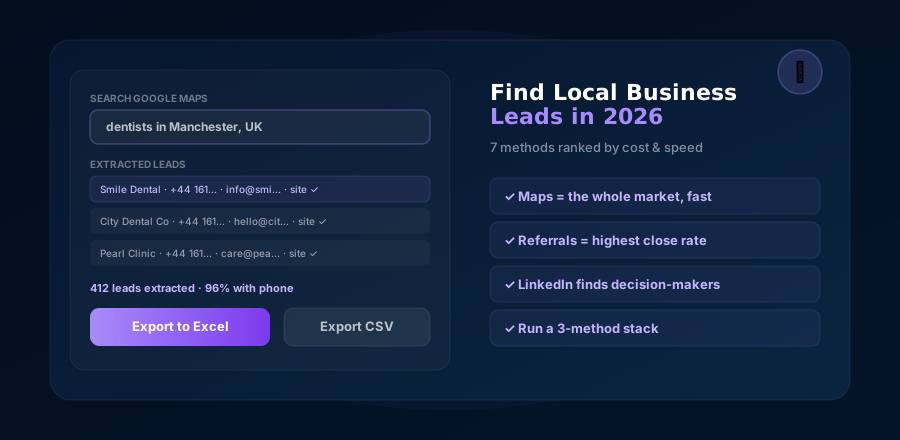
Google Maps is the definitive registry of local business — more complete than any directory because businesses maintain their own listings to be found by customers. Extraction software turns it into lead lists: search "niche + city" in Business Lead Extractor, and minutes later you have every dentist/salon/restaurant/manufacturer in the territory with phone, email, website and socials in Excel.
- Why it ranks first: no other method produces a complete territory picture. Referrals and networking give you leads; Maps gives you the market.
- The qualification bonus: extracted fields double as qualification data — the no-website column IS the prospect list if you sell websites; missing socials flag social-media-management prospects.
- Workflow: extract → clean → segment → multi-channel outreach. The complete system guide covers each stage with benchmarks.
₹3,000 / $35 per year · No subscription · Access via WhatsApp
2. Referral Systems — Highest Quality, Never Enough Volume
Cost: free · Speed: slow · Volume: low · Quality: the best there is
A referred lead closes at 3–5× the rate of a cold one. The mistake is treating referrals as luck instead of a system: ask every happy client at the moment of delivered value ("Who else do you know who needs this?"), make it specific ("any other restaurant owners on this street?"), and reward it visibly. Referrals compound beautifully on top of a volume method like Maps — your extracted-list clients become referral sources.
3. LinkedIn — Best for Finding the Decision-Maker
Cost: free–$$$ · Speed: medium · Volume: medium · Quality: high for B2B
Maps tells you the business exists; LinkedIn tells you who owns it. For deals above a few hundred dollars, the combination is the power move: extract the company list from Maps, then find the owner/manager on LinkedIn for a personal approach. LinkedIn alone skews corporate — many local business owners barely use it — which is why it pairs with rather than replaces Maps data.
4. Business Directories — Justdial, Yelp, Yellow Pages & Friends
Cost: free–$ · Speed: medium · Volume: medium · Quality: mixed
Directories were the pre-Maps answer and still add value in specific markets (Justdial/IndiaMART density in India, Yelp for US hospitality, niche trade directories everywhere). Coverage overlaps Maps heavily, listings decay faster (dead businesses linger), and manual collection is slow. Use them to supplement a Maps list in niches where a directory is culturally dominant, not as the primary source.
5. New-Business Registries — Catch Them at Day Zero
Cost: free–$ · Speed: weekly rhythm · Volume: low · Quality: very high for the right offers
Company registration data (MCA in India, Companies House in the UK, state registries in the US) lists businesses at the moment of birth — when they need everything: accounting, websites, branding, insurance, equipment. If your offer fits new businesses, a weekly registry check for your territory is a small, rich stream competitors mostly ignore. New Maps listings serve the same purpose for storefront businesses.
6. Trade Associations & Chambers of Commerce
Cost: free–$$ (membership) · Speed: slow · Volume: low-medium · Quality: high trust context
Member directories are pre-qualified lists (serious enough to pay dues), and association events put you in rooms with them. The play is patience: association selling is relationship selling, and the directory works best as a warm-ish call list after you have shown your face twice.
7. Local Networking — Facebook Groups, WhatsApp Communities, Meetups
Cost: time · Speed: slow-burn · Volume: low-medium · Quality: high when it lands
Local business owners cluster in Facebook groups and WhatsApp communities, and visible helpfulness there generates inbound over months. It is real but slow — run it as a background process alongside the volume methods. (The systematic version: Facebook Groups for Lead Generation.)
The 3-Method Stack That Actually Works
Nobody runs seven methods well. The stack that fits most local B2B sellers:
Maps extraction as the engine
Complete territory lists, refreshed monthly, feeding calls/email/WhatsApp. This is your predictable volume.
Referral system on every closed deal
The quality layer. Costs one question per happy client.
One relationship channel you enjoy
LinkedIn, the chamber, or local groups — whichever you will sustain. Consistency beats channel choice.
Bottom Line
Local lead generation stops being mysterious when you see the seven sources plainly: one gives you the whole market in a spreadsheet (Maps), one gives you the best-closing leads (referrals), and the rest add texture. Start where volume is instant: pull your first territory list as soon as you are set up, and let the other methods compound around it.
See Business Lead Extractor Pricing →Where this trips people up
The classic failure pattern is method-hopping: two weeks of LinkedIn, no clients, switch to directories, three weeks, switch again — every method abandoned exactly at the point where it was about to produce. All seven sources work; none works in a fortnight. Pick the three-method stack and commit for a quarter. The subtler mistake is mismatching method to deal size: driving to chamber breakfasts to sell a ₹5,000 service loses money on petrol, while cold-calling from a raw list to sell a ₹5 lakh engagement underpowers the approach that deal deserves. Volume methods for volume economics, relationship methods for relationship economics. And one more: people treat their extracted Maps list as disposable after one pass. That list is an asset — the "no thanks" of March is the "actually, yes" of August, if anyone bothers to keep the spreadsheet and follow up.